
Dickenson Release Dates: Planned or Final
A projected, estimated, or scheduled date is a calculation made before the custody event. The label may appear on a state locator record, in a jail computation, or in agency correspondence. The actual release date records what happened after staff resolved the sentence, credits, warrants, detainers, transfer orders, and release processing. A future field remains a projection even if its label omits that word.
Pretrial custody works in another way. A Dickenson defendant awaiting trial has no sentence-completion date. Bond may authorize release, but every hold must clear and SWVRJA must complete processing. A dismissal may end one charge while another case keeps the person confined. A move from the Haysi Facility to another SWVRJA building or to VADOC is a transfer, not community release.
“Active time” means the part of a sentence that must be served, subject to lawful credits. “Suspended time” is held back by the court under stated conditions. Concurrent terms run together, while consecutive terms run one after another. Those basic differences can move the calculation by months or years.
Find a Dickenson Inmate Release Date
Begin by identifying the custodian. The authority-wide SWVRJA current-inmate view covers Haysi, Abingdon, Duffield, and Tazewell. The VADOC Inmate and Supervisee Locator is for state prisoners and many supervisees. A negative result in one system cannot be turned into proof of release.
- Obtain the signed sentence and all amended or revocation orders. Separate active time from suspended time and note each offense date.
- Confirm whether the person is pretrial, serving a local SWVRJA term, or committed to VADOC. Transfers among custodians are not release.
- For a state prisoner, search the locator by full name or VADOC number. Open the detail and copy the exact status, date label, date value, and day checked.
- For a local term, call the SWVRJA Haysi information line and use the sentence or case number. Ask which office holds the computation record.
- Check all credited presentence confinement and ask the computing authority to explain any later change. Do not assume all days or all convictions earn the same rate.
- After the projected day, obtain the release or discharge record. That final record distinguishes community release from a move to another custodian.
The official locator image is introduced by VADOC’s locator explanation and launch page.
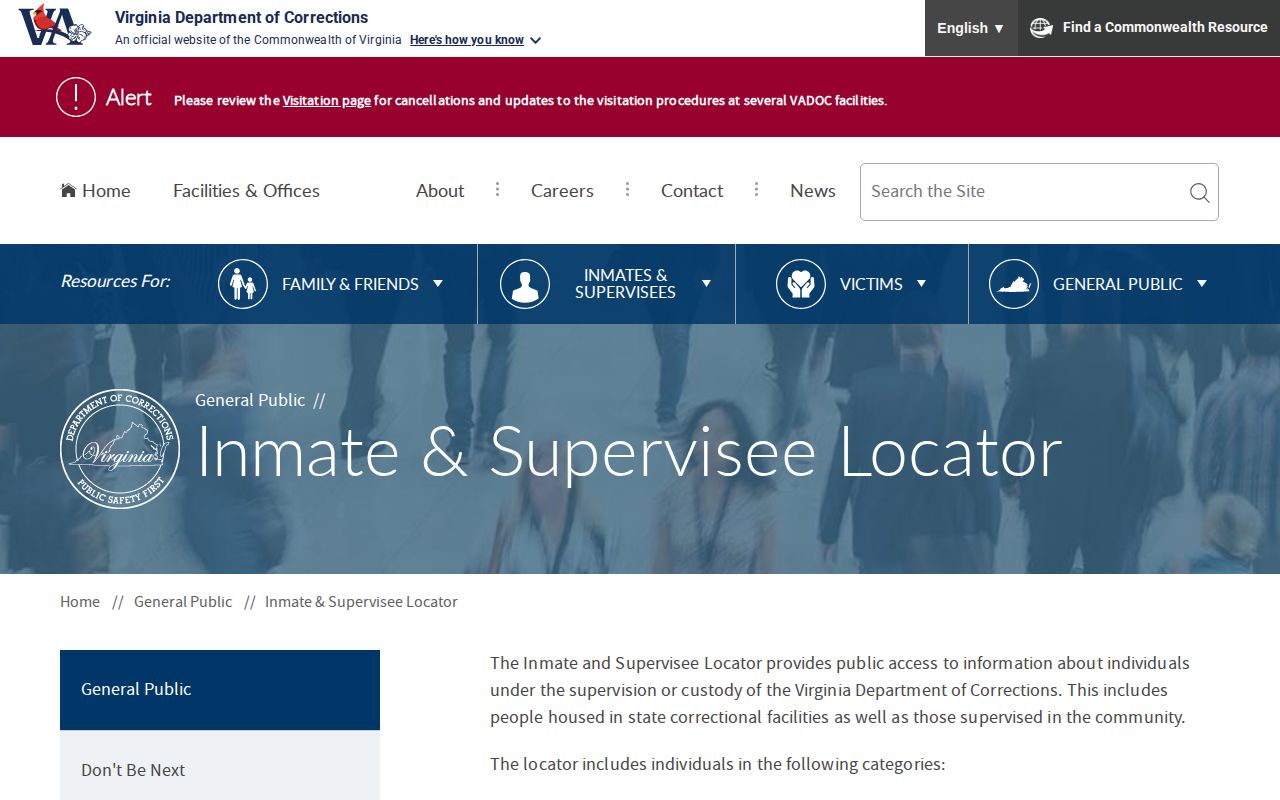
The record view should be read by its live labels. It may show an estimated or other release-related date, but the interface can change and the agency remains the source of the computation.
Note: Save the date of each locator check because VADOC says results update daily but may still be inaccurate or out of date.
Dickenson Release Credits Vary by Sentence
Virginia uses more than one credit framework. VADOC says Good Conduct Allowance generally governs felony offenses committed before January 1, 1995 and misdemeanors committed before July 1, 2008. For eligible parole-era sentences with more than twelve months of active time, the computation may include parole eligibility, mandatory-parole release, and good-time dates. Virginia Code § 53.1-202 supplies an initial allowance and addresses certified prior confinement; class-based rates can range from no credit to thirty days for each thirty days served.
Earned Sentence Credits generally apply to felony offenses committed on or after January 1, 1995. Sections 53.1-202.2 through 53.1-202.4 address eligibility, rates, classification, rules, and forfeiture. As researched on August 8, 2026, listed offenses in subsection A of § 53.1-202.3 could earn at most 4.5 credits for each thirty days served. Other eligible offenses used class levels of fifteen, 7.5, 3.5, or zero days per thirty.
Classification is reviewed at least each year and may change. Credits can also be forfeited under departmental rules. Earned credits do not reduce the time that must pass before parole eligibility. The law in force for the relevant offense and calculation date controls, and the Code displays later effective versions for some provisions.
- Presentence credit
- Qualifying time in custody before the final sentence is credited toward active time.
- Good Conduct Allowance
- The older class-based credit system for covered sentences.
- Earned Sentence Credit
- The post-1994 felony credit system with offense and class limits.
- Forfeiture
- Loss of credit under authorized disciplinary rules.
No Universal Dickenson Release Formula
The familiar statement that a Virginia inmate serves “at least 85%” is only shorthand for part of the post-1994 truth-in-sentencing model. It is historically tied to a maximum rate of 4.5 days of credit per thirty days served for some sentences. Current law has offense-specific limits and other rates. Applying 85 percent to every sentence would misstate both older Good Conduct Allowance cases and newer cases eligible for different Earned Sentence Credit levels.
The local boundary adds another layer for Dickenson County. Virginia Code § 53.1-131.1 addresses credits for covered terms in local correctional facilities. No official SWVRJA page publishes a Haysi release calculator, fixed early-release chart, or weekend rule. For a local sentence, the useful path is the court order plus the SWVRJA computation record, not a VADOC estimate intended for state custody.
Can sentence length alone yield the date? No. Offense date, active time, prior credit, class, discipline, and controlling orders must all be applied by the right agency.
Why Dickenson Release Dates Change
VADOC identifies jail time before receipt, sentence type, total active sentence, credit-earning class, disciplinary offenses, and computation events as key variables. A projected date may move forward or backward when the agency receives better records or applies a lawful change. The reason should be traced to the record rather than guessed from two screenshots.
| Factor | Possible effect | Best verification |
|---|---|---|
| Corrected court order | Changes active, suspended, concurrent, or consecutive time | Signed amended order and recomputation |
| Presentence credit | Adds qualifying prior custody time | Certified jail credit and agency calculation |
| Credit class or discipline | Changes earning rate or forfeits credit | VADOC or local computation record |
| New sentence or revocation | Adds active time or alters sentence structure | New court order |
| Detainer or hold | May prevent community release on the projected day | Sending and receiving agency records |
| Parole action | Affects a legally eligible state case | Board decision followed by VADOC status |
| Administrative correction | Fixes stale or incomplete inputs | Written explanation from computing authority |
A detainer is a request or legal basis for another authority to take custody. SWVRJA may close one booking while VADOC, another jail, federal authorities, or ICE continues confinement. That is why a local release timestamp and freedom in the community are not always the same event.
Note: A date change is not proof of misconduct; corrected papers or newly certified credit can also alter the calculation.
Confirm Dickenson Actual Release Dates
For a SWVRJA release, request the booking-and-release entry with the date, time, category, and receiving agency if a transfer occurred. For a VADOC case, request a release letter or official record if the public locator lacks enough detail. Pair either record with the sentencing order when the reason for the date matters.
Virginia VINE can send a custody-change alert for people held in local and regional jails, including SWVRJA. It is event notice, not a certified release record. State-prison victim notification follows a separate VADOC Victim Services and NAAVI route, while the public locator supplies general state custody information. The Dickenson VINELink release check explains that local and state boundary.
For a disputed VADOC calculation, write to the Virginia Department of Corrections, ATTN: Correspondence Unit/Court & Legal Section, P.O. Box 26963, 6900 Atmore Drive, Richmond, VA 23261. Include the VADOC number and identify the date field or sentence term in question. For a local term, begin with SWVRJA Haysi at (276) 679-7880 and the Dickenson sentencing court.
The release record should be requested from the agency that performed the final custody action. For Haysi, ask SWVRJA for the release or transfer transaction linked to the booking number. A direct community release may reflect bond, time served, sentence completion, dismissal, or another authorized category. A transfer entry should name the receiving agency when that field can lawfully be disclosed. If the person entered VADOC, the state locator and state release document become the stronger sources for the later state sentence. Court records can explain the order but may not show the exact hour staff completed release.
Dates should also be matched to the correct case. One person can have several charges, sentences, or holds. A disposition in one Dickenson matter does not clear a separate case. Compare the case number, VADOC number, booking number, and full identity wherever the source supplies them. When records conflict, ask what each timestamp means. Order entry, transport, intake, and physical exit are distinct events, so two accurate agencies may display different times without either record being false.
Final discharge is another separate milestone. A person may leave prison and remain under parole, probation, or mandatory supervision. The projected prison-exit date does not necessarily mark the end of the full sentence. Review the VADOC status or supervision district and the controlling order before describing the person as discharged. An official release letter or discharge record is the sound endpoint when the public result lacks enough detail.