
Dickenson Parole and Probation Compared
Virginia divides the authority to order supervision from the work of supervising a person. A Dickenson County court orders probation through a sentencing or revocation order. The Virginia Parole Board grants discretionary parole or one of the conditional-release forms within its legal authority. Virginia Department of Corrections Community Corrections officers then supervise many people in both groups. That shared field staff can make parole and probation look alike, but their legal sources remain distinct.
Probation may follow a jail term, or a judge may suspend all or part of a term and place the person on probation. It therefore does not prove that someone left a state prison. Parole is release from state incarceration under conditions for a prisoner who falls within an eligible category. Most Virginia felony offenses committed on or after January 1, 1995 do not carry ordinary discretionary parole, subject to statutory exceptions.
| Point | Parole | Probation |
|---|---|---|
| Who authorizes it | Virginia Parole Board for an eligible prisoner | Dickenson County sentencing court |
| What it follows | Release from state confinement | A sentence that may include active or suspended time |
| Best source | Board decision, VADOC status, and release record | Signed sentencing order and VADOC supervision record |
| Who supervises | VADOC Community Corrections | VADOC Community Corrections in covered cases |
| How it ends | Final discharge or other Board/VADOC action | Court-ordered completion or discharge |
- Parole
- Conditional community release from a qualifying state sentence before final discharge.
- Probation
- Court-ordered community supervision that may accompany suspended incarceration.
- Discharge
- The formal end of custody or supervision, not just release from a building.
- Absconder
- A supervisee alleged to have stopped reporting or left supervision without authorization.
Check Dickenson Post-Release Supervision
The VADOC Inmate and Supervisee Locator is the public starting point. Its name matters. The tool covers more than people in prison and may identify a community location or probation and parole district. A result should be matched by a seven-digit VADOC number when known, since names can be shared or entered in more than one form.
- Search by first and full last name, or use the VADOC number. Apply location, age, race, or gender filters only when they help distinguish results.
- Open the matching detail and read the exact status. A community or district location supports release from physical state confinement into supervision.
- Record the date checked. VADOC says the locator updates daily, but it also warns that information may be inaccurate or out of date.
- Use the VADOC facility and office finder to locate the district shown on the record, then call that office for routing.
- Compare the locator with the signed Dickenson sentencing order or parole record. Those documents define the authority, term, and conditions.
- If no result appears, check the sentencing court. An alias, local or unsupervised probation, data lag, or completed supervision can explain a miss.
The Dickenson County released-inmate search path can help establish whether the earlier event was community release, a transfer within SWVRJA, or commitment to VADOC. That custody history should be settled before a community-supervision result is interpreted.
Note: A locator result is a useful lead, but the signed order or official certificate controls the terms of an individual case.
Dickenson Supervision Through District 18
The VADOC office finder lists Norton, District 18, as the relevant regional probation and parole office, with additional offices in Duffield and Clintwood. The live directory’s “Areas Served” wording has appeared inconsistent with those satellite locations. A reader should not infer a firm Dickenson assignment from a map pin alone. Call District 18 and give the reporting location shown on the VADOC record.
VADOC Norton, District 181650 Park Avenue SW
Norton, VA 24273
(276) 679-9201
Additional offices are listed in Duffield and Clintwood.
Office staff may confirm whether the displayed district is the right reporting contact and explain how the person should communicate with it. They may limit facts due to safety, privacy, or supervision rules. Conditions should come from the signed probation order, parole certificate, or supervising officer, not from a general description on an office page.
The office-finder image comes from the official VADOC facilities and offices directory.
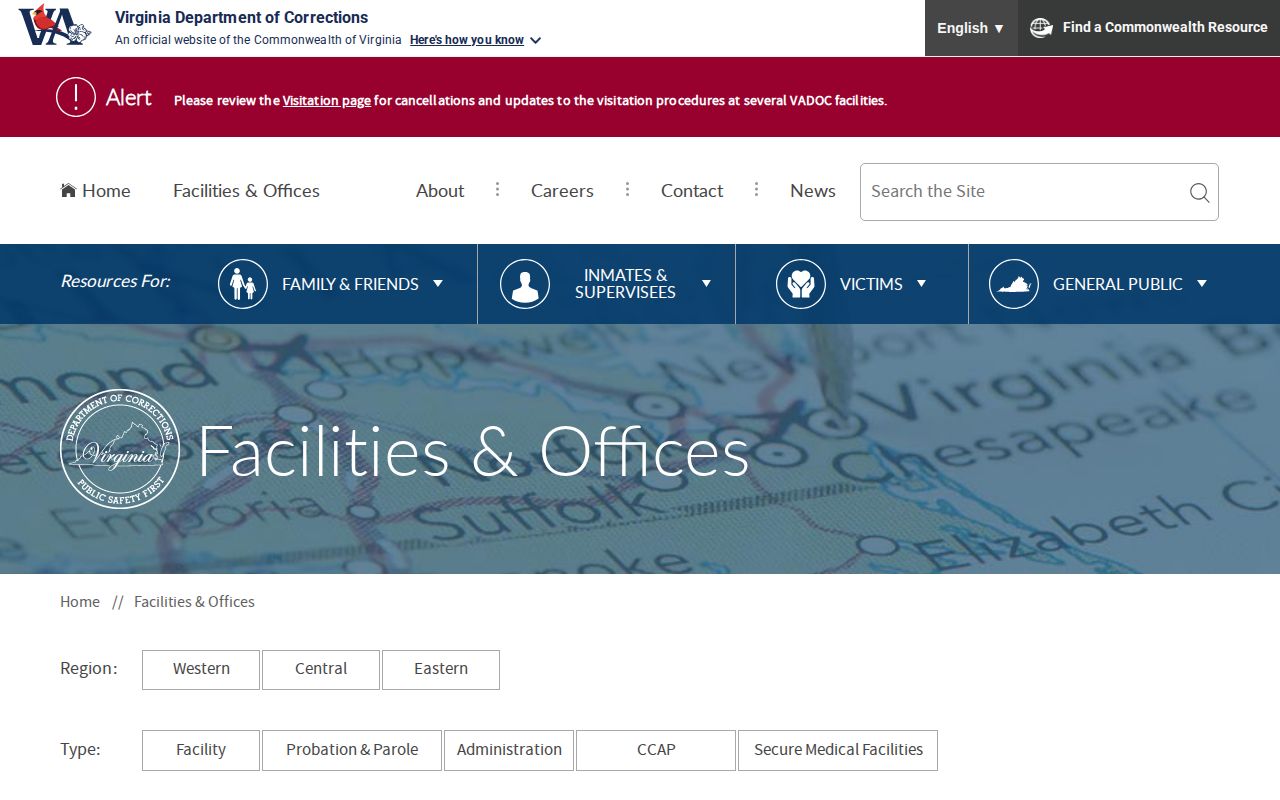
Its search and filter interface is the right way to confirm current district listings because office assignments and directory text can change.
Dickenson Parole Meeting Calendar
The Virginia Parole Board’s Public Meetings page is a live calendar, not a full list of every eligible prisoner. It posts upcoming meeting times, agenda files, viewing information, and past minutes. Since July 1, 2024, a public final deliberation and vote by videoconference occurs when the Board is inclined to grant discretionary parole or geriatric conditional release. The Board states that an agenda is posted at least three working days before that meeting.
Absence from the calendar proves very little. It does not establish ineligibility, denial, lack of review, or continued confinement. The public-meeting stage has a defined inclined-to-grant scope. Check the live calendar instead of relying on a saved future date, because schedules change and a static date soon becomes stale.
Does a hearing date show when release occurs? No. A hearing or public-vote date records a Board step. VADOC still completes release processing, and another valid hold or sentence can affect the physical exit.
Dickenson Parole Decisions and Release
The Board’s Parole Reports archive publishes decision PDFs by month. Virginia Code § 53.1-136 requires a monthly public statement with the person’s name, offense and jurisdiction, sentence information, time served, grant or denial, individualized reasons, and final vote. The Board says reports appear at the end of the following month after required notices. It is not a real-time release feed.
A grant confirms the Board outcome. It does not confirm the date a facility opened its door. After finding a grant, review the VADOC locator’s current status and obtain release documentation if an exact event matters. A denial is also a Board action, not a new county-jail status. The hearing calendar, monthly decision archive, and VADOC release record answer three different questions.
| Source | What it establishes | What it does not establish |
|---|---|---|
| Public meeting calendar | Scheduled public Board event and agenda | A complete eligibility list or release date |
| Monthly parole report | Grant or denial, reasons, and vote | The physical release time |
| VADOC status or release record | Custody, supervision, or completed release event | The legal reasons found only in every Board or court file |
Note: Publication lag means a recent decision may not yet appear in the monthly archive even when the Board has completed its work.
Dickenson Parole Eligibility Boundaries
Virginia Code § 53.1-165.1 abolished discretionary parole for most felony offenses committed on or after January 1, 1995, while preserving stated exceptions. Potential categories include older offenses and narrow statutory routes involving some jury sentences, juvenile sentences, geriatric cases, terminal illness, misdemeanors, or Youthful Offender Act sentences. The offense date and signed judgment matter more than a general statement that a person is “eligible.”
For many parole-era sentences, § 53.1-151 gives tiered first-eligibility fractions and caps based on prior commitments. It also contains exclusions and rules for concurrent or consecutive terms. Those details prevent a sound calculation from sentence length alone. VADOC and the Board should make the individual determination.
Dickenson Supervision Violations and Warrants
Typical conditions can govern reporting, travel, treatment, contact, payments, and compliance with law, but the exact terms come from the person’s order or certificate. An alleged violation may lead to officer action, a court hearing, Board action, or a warrant. It does not by itself prove a new conviction or show that every form of release has ended.
No complete, official, name-searchable Dickenson County probation or parole absconder list was found. VADOC’s selected “Most Wanted” material is not a full supervision database. Likewise, a warrant does not prove that the person was released in the custody episode under review. Verify a warrant with the issuing court or law-enforcement channel and verify supervision separately through VADOC.
Virginia VINE is useful for local and regional jail custody changes, including SWVRJA. It is not a supervision-status service. If a violation causes a new jail booking, VINE may report that custody event, while the officer, court, or Board record explains the supervision action.
Dickenson Supervision Ends by Discharge
Leaving prison or jail is not the same as completing a sentence. A person may be in the community under parole, probation, or another form of oversight. Final discharge is the formal end of the relevant custody or supervision term. The most useful proof may be a VADOC discharge record, court order, release letter, or Board document, depending on who imposed and managed the supervision.
Start with the current locator status, then request the controlling document when the end date matters. A missing locator record alone is not enough. Completed supervision, an alias, delayed data, limited public coverage, or a different supervising system can all cause a no-match. The result should be read with the sentence and with any later revocation or amended order.